Showing posts with label Dr. Some's Steampunk ABC. Show all posts

13 June 2013

Dr. Some's ABC of Steampunk Part 7: S - U

S is for Steam

A big steam engine!
Steam! Thats what is all about! It is the main power-source and (quite obviously) namesake for steampunk! There might be other technologies as well, like primitive chemical batteries or even green energy like wind-power (just think of sails!), but they are all overshadowed by happily smoking and rattling steam-engines!

As rule of thumb you can say: wherever are moving parts, there can has to be a steam engine. Don't restrain your imagination with steam driven trains or ships or maybe airships only. There are countless applications! You are too lazy to wind up your clock? Make it steam driven! Shoveling coal with a spoon-sized shovel is so much more fun! And it has so many more moving parts (see "O is for Over-engineering"). Steam robots with mechanical brains are also great. Or steam driven coffee machines, gramophones or organs (they really exist and are called calliopes!). Did someone just say steam-driven toothbrushes? Great idea!

Pretty big actually!
The historical roots of steam engines go back into the 17th century and are mostly focusing on things like pumps to drain the groundwater from mines (no-one back then even considered steam-powered toothbrushes - imagine!).
For decades the power and reliability of steam engines remained less than desirable. It took until 1776 to fully unleash their potential with a dramatically improved design by James Watt and his business-partner Matthew Boulton, which literally did boost industrialization.

Steam-power was irreplaceable for the technology of the 19th century and even in our modern times there are applications where steam is still the best available technology. Solar thermal-power plants, coal plants and even our "beloved" nuclear plants - all are working by the same principle:
A heat source (the sun, fire, or a nuclear reaction) transforms water into high pressurized steam, which drives a steam turbine, which mechanical power drives an electrical generator... well, I'm sure you can guess the rest now.

Oh and finally technology did advance far enough to bless us with - the steam powered toothbrush! The world is good!


T is for Tunes

Not Steinway but Seaway!
Emma playing on a original Captain-Nemo-organ!
After intense acoustic research (as in "listening to lots of music") I am pleased to say that there is quite an amount of diversity amongst what people call steampunk-music. And despite the media focusing on a few bands (I didn't say "Abney Park" now!): there is not the definite steampunk sound and I am very happy about this. There are lots of different shades. And we love diversity, don't we?

There are the Victorian/industrial sounds of "The Clockwork Dolls", the goth-rooted "Abney Park", the industrial-hip-hop-operas of "Dr. Steel" (who did sadly retire), the Gothic Lolita violinist "Emily Autumn" and the wide and colourful universe of bands like "Vernian Process", "Beats Antique", "Steam Powered Giraffe", "Stolen Babies", "Katzenjammer", "Ghostfire", etc etc...

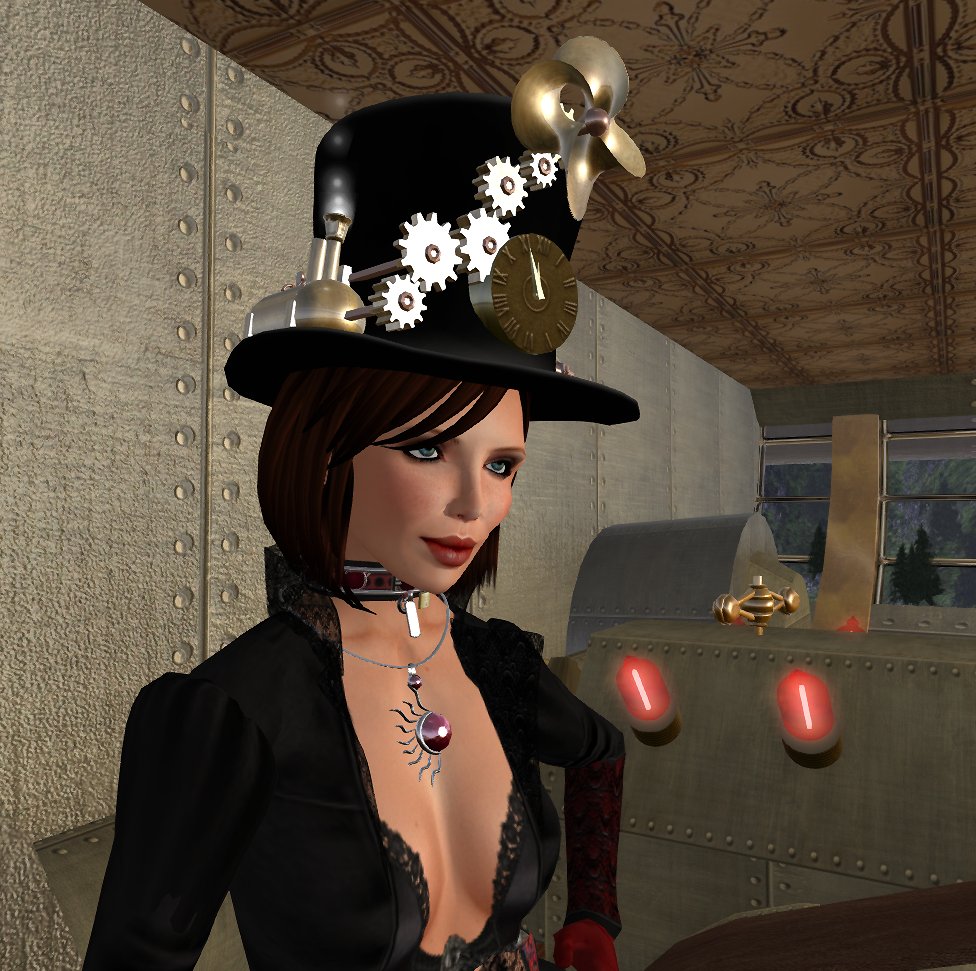
Rockstar Drow!
The influences of steampunk music is very diverse. Apart from rather obvious gothic influences (bands like "Fields of the Nephilim" with their gothic-cowboy-look were surely inspirational), there is a strong influence of classical music, cabaret and vaudeville, movie soundtracks, electro, industrial, folk, metal or even hip-hop and trip-hop. It all works and the musicians usually really know how to play!

This richness in styles is also reflected by the sheer number of different instruments. Besides commonplaces like guitars (electrical and acoustic), bass, drums and keyboards there is a wide variety of classical instruments too. Especially pianos, violins (lots!), cellos and wind instruments. Typical folk instruments like bagpipes, accordions and banjos are also popular, as well as really weird things like the theremin (once known as aetherphone - there we go!), musical saws, calliopes (see "S is for Steam") and (greetings to Mike Oldfield) tubular bells!

Concluding you can say the only thing all steampunk bands have in common is a creative mix of old and new. It is a very vivid and colourful movement with influences from countless directions. Lets hope it stays so diverse. With mainstream success comes often uniformity and uniformity kills creativity. Other genres went that path and did fade into triviality.


U is for Utopia

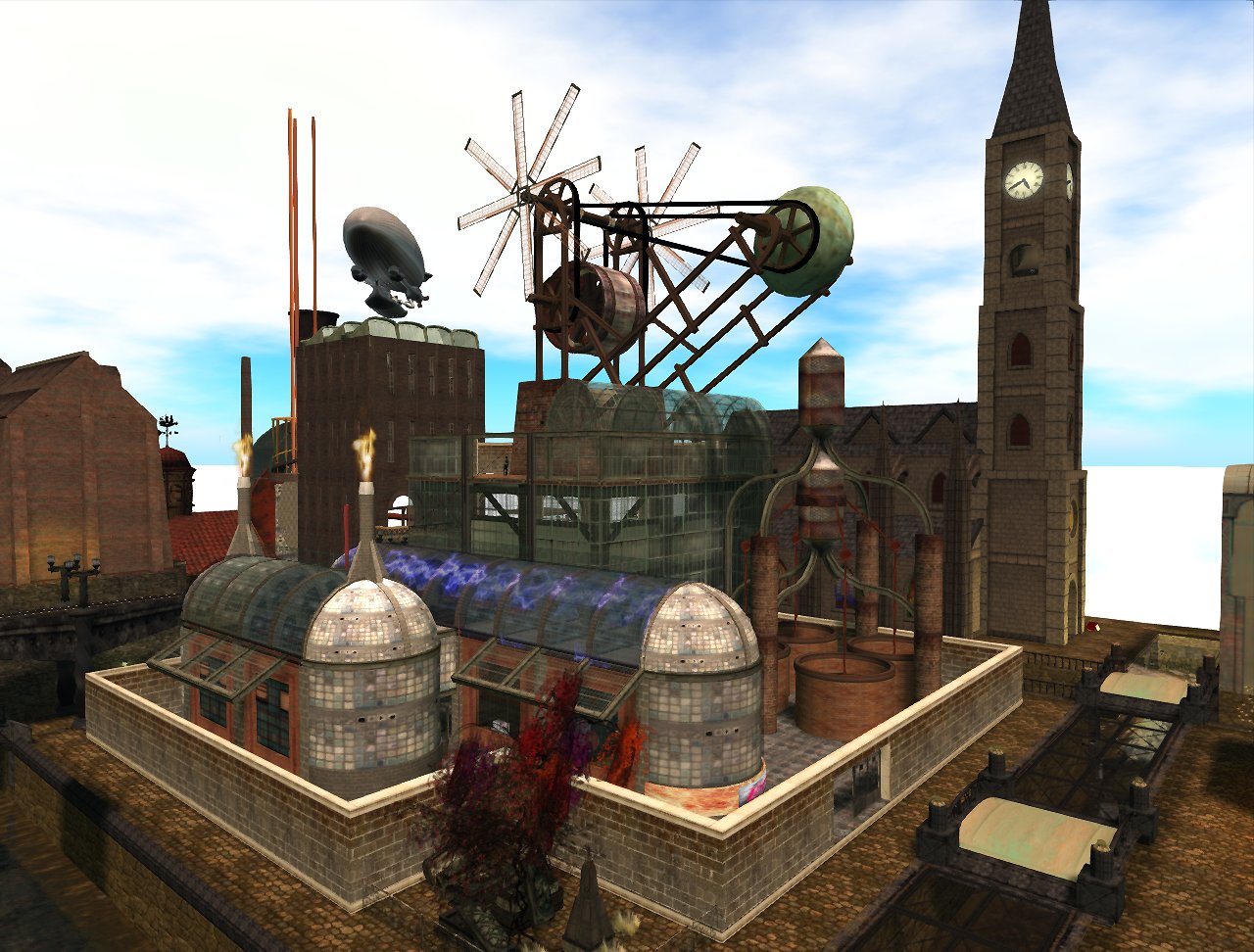
Utopian looking, but actually a Forgotten City!
The world of steampunk is an ideal, whimsical nostalgic parallel universe. A world that never was and which is therefore simply a better place is than our modern, increasingly complex life.
Technology is usually a blessing there, solving the problems of humanity, or it at least replacing them with new, more entertaining ones! And contrary to its modern counterpart steam-technology its even fun looking!

This of course doesn't means steampunk doesn't know evil. There are plenty colourful villains - just think of the mad scientists! However even evil in steampunk gets quite the sympathy credits. Its just a much more appealing idea to have the world taken over by a Dr. Steel than by your typical real-life-dictator, isnt it?

The utopia steampunk represents is much like the renaissance/medieval-revival and shares many similarities with it: Its both an escape. An idealized world that did never exist (and where people won't really feel comfortable in) with fancy clothes, often self-made in many many hours of patient work and - yes, a healthy amount of nerdiness too!

20 May 2013

Dr. Some's ABC of Steampunk Part 6: P - R

P is for Pirates

This is not an air pirate-ship!
(Thanks to Zen Wickentower for the lovely craft!)
Yarr! Don't think that the only pirates nowadays are either Johnny Depp or Somalians. The steampunk skies are filled with dangerous air pirates!

Much like their 18th century counterparts of the Caribbean they have usually secret pirate lairs, hunt treasures, kidnap princesses, trade slaves and - board other ships!
Preferred bounty, apart from obvious things like gold, jewels and treasure maps, are exotic devices, strange artifacts and mad inventions which enable their owners to take over the world (which of course is always an excellent starting point for adventure-stories!).

A stylish not-air pirate!
They use usually well armed air ships, mostly in the classical zeppelin-style or as flying galeon (complete with rigging, jolly roger and stuff!), though there were sightings of pirates using airplanes too. The author of this lovely blog got even incarcerated and accused to be one by herself! (see here, here and here) Just because her red biplane did look suspiciously similar to one the notorious Red Baroness does use for her raids! Of course these accusations were untenable and resulted in a release from prison without even a trial! Just good that the booty was nicely and securely hidden, they didn't had any evidence *evil laughter* - Hey! Did write that loud???

Anyway, steampunk pirates are not only a serious threat to peaceful aeronautics, you also should not underestimate the impact the have on fashion! The dashing female air pirate combines useful equipment (the inevitable belts with guns, knifes and perhaps a cutlass too) with a sexy look, employing leather corsets, boots and skillfully omitting cover at just the right spots - delicious!


Q is for Queen Victoria

Me and Queen Victoria
One of the words you hear quite frequently when it comes to steampunk is "Victorian". This term comes from the "Victorian Era", the time when Queen Victoria ruled the British Empire with its colonies (which was all in all about 1/5th of the world's population. So yes - it was a big empire!).
The world of Queen Victoria is the ideal where steampunk builds upon (well, visually at least). Its literally impossible to think steampunk without at least a bit of its technology, fashion or design with its typical ornamentations.

During Queen Victoria's reign (from 1837 till her death in 1901), the industrialization was in full flight in the western world and it affected people's life significantly. In a way like the Internet does today. Steam engines allowed mass production and mass transportation: Factories were mushrooming, dragging millions from the countryside into the big cities on the search for work whilst steam-powered trains and ships shortened transportation ways, making the world a significantly smaller place.
Being the technologically leading nation in that "industrial race", Britain was the most important political and economical player of its time with trade routes and colonies all over the world.

Socially however the British Empire was faced with inner tensions. The industrialization didn't bring wealth to everyone. Huge fortunes did exist next to mass poverty and people working under terrible conditions (sounds a bit like today's China, hm?), there were riots in the colonies and the moral standards of the Victorian Era war from being progressive - especially regarding the role of women in the society.

So its a two-edged sword. Visually its a great time, giving sheer endlessly inspiration for creative people, but I don't think nowadays humans would feel well in that world - just think: no premarital sex!


R is for Robot

Robots seem to have not really much to do with steampunk and they occupy indeed rather a niche there. However a quite interesting one.
They are at the first glance typical inventions of the 20th century. First in science fiction, then in reality (where they are mostly doomed to be either be silly blinking or barking toys or weld together cars). But thats just one part of their long and peculiar story. Lets start with their earliest predecessors, the golems:

The golem (which first appeared in the 12th century) was of course a rather simple creation. You take a piece of clay, give it roughly human shape, do your secret rituals (likely found in the Jewish Kabbalah) and finally put a slip of paper under its tongue with some magic words written on it, much like a modern day operating system (lets do a neologism and call it "Clay OS").

China MiƩville (see "L is for Literature") picks up the idea of the golem for his novel "Iron Council" where one of the main characters learns to create them, eventually leaving the medium clay far behind. He creates railroad spike golems (which try to hammer themselves into the track), wind golems attacking airships and finally even a time-golem!

Much more technological than the golem and therefore closer to the general understanding of what a robot is, is The Turk.
The Turk was Invented in a time where the understanding of nature was a mechanistic one and therefore all living beings were - in a sense - machines.
Invented in 1770 by Wolfgang von Kempelen The Turk did amaze its audience: It was an elaborate high-tech chess playing automaton in the shape of a human (in this case a Turk, I'm sure you'd never guessed that!), sitting on a chair before a chess table. After its human contender made a move, The Turk (capitals make its name look more pompous, you know) rattled, reached out its arm and moved its piece like by magic, driven by its elaborate calculating mechanism.
Of course it was a hoax, with a small human (not necessarily a Turk) chess-player hidden underneath the table performing all the moves, as they found out only 50 years after its creation. Silly humans.

The Turk did prove two things, which are still valid today: 1) Its very easy to fool humans, and 2) its somehow expected that a robot looks at least roughly like a human being. Especially in science fiction you will hardly find a robot, which is not looking humanoid. If its the mechanical Maria in Fritz Lang's masterpiece "Metropolis" (1927), the robot in the series "Lost in Space" (1965 - 1969) or in Isaak Asimov's Robot-Stories like "The Caves of Steel" (1954).

Robots (or sometimes called "Clanks") in steampunk are - which will surely surprise you to hear - usually steam driven and possess a mechanical brain contrary to their electronic counterparts of the modern world. They are often operated via punch-cards (which is an interesting analogy to the golem) and are ideal for mad scientists like Dr. Steel to form great armies of them to take over the world!
Robotic body parts are also very popular, especially for villains who lost a limb or two by unspeakable experiments (or plain foolishness). Also its handy for them to have, if its not a heart of steel, at least one made of corrosion-resistant brass.

14 May 2013

Dr. Some's ABC of Steampunk Part 5: M - O

M is for Movies

Movies played a big role in defining the distinctive steampunk look. One of the earliest is the Jules-Verne adaption "A trip to the Moon" from 1902 (here is a german dubbed version).
The 1950s and 1960s saw a number of big film productions which picked up the now retrofuturistic theme and made it accessible for a whole new generation, even if the invention of the term steampunk was some 30 years away still.
These films were mainly (more or less close) film adaptations of the stories of the "godfathers of steampunk" Jules Verne and H. G. Wells. Movies like "20,000 Leagues under the Sea" (1954), "The Time Machine" (1960, my first contact to something steampunk!), "First Men in the Moon" (1964, turned into a hilarious comedy about the space-race) and "Captain Nemo and the Underwater City" (1969, not a purebred, but quite the fun to watch nevertheless) featured a lovely whimsical setting, which became a blueprint for what we know today as steampunk.

Things became quiet after the 1960s however and it took until 1990 that people saw something notably steampunky on the big screen again. I think many will remember the final scene of "Back To The Future III" where Doc Brown flies off in his steam train time-machine (together with his wife and his sons Jules and Verne - quite the insider-joke, isn't it!).
"Edward Scissorhands" from the same year showed us some steampunk-elements too. Together with a modern variant of the good ol' Frankenstein-theme (Edward's creator was none other than Vincent Price in his last role!), which is actually much more in the spirit of Mary Shelley's original story than the millions boo!-scary-monster!-movies usually adapting the story.
The french film "The City of Lost Children" (1995) also features strong steampunk visuals, together with a lovely oddness, which made already "Delicatessen" (1991, both by Jean-Pierre Jeunet and Marc Caro) a deliciously weird classic.
After the 90s were getting ahead pretty promising with innovative and fun movies, Hollywood decided to make a big big steampunk production with a big big budget. Luckily "Wild Wild West" (1999, yes - that movie) didn't do lasting damage to the genre.

"The League of The Extraordinary Gentlemen" from 2003 was some kind of best-of-19th-century-adventure-literature-mixtape, featuring well known and lesser known characters like Count Dracula, Captain Nemo, Allan Quartermain, Dorian Gray, Dr. Jekyll and Mr. Hide and many, many, many more. And it was quite fun, as long as you didn't took it too seriously.
Also notable is the Japanese anime "Steamboy". A very ambitious project which was 10 (!) years in the making (never a good sign btw.) and failed to reach its audience when it was finally released in 2004.
Visually much stronger (and also much cheaper in the production) are "The Mysterious Geographic Explorations of Jasper Morello" from 2005. A series of short GC-animated films which really shows some potential. The first part of Jaspers Expeditions (which have quite the Lovecraft/Poe lacing) has been released on Youtube, to get its viewers addicted and wanting to buy all episodes.

More recent live-action productions with steampunk-elements are "The Golden Compass" (2007 also including cheesy Narnia-like fantasy) and Martin Scorsese's amazing "Hugo" (2011), featuring lots of gears and automations and a really touching and fun story.
Yes, there is a number of films I didn't cover - but just might not have credited them with enough importance to be mentioned here ;-)


N is for Nemo

The world's most famous submarine - the Nautilus!
Captain Nemo, commander of the submarine Nautilus in Jules Vernes famous "20,000 Leagues under the Sea", is one of the strongest and most interest characters in steampunk literature and perhaps in the literature of the 19th century as a whole. He is somewhat time-less. And thats the virtue of his character: His past is an enigma (if we ignore the dispensable and anachronistic 1874 sequel "The Mysterious Island"), his actions are driven by revenge and the deep feeling of being an outcast from mankind and his crew is willing to follow him and his goals till death.

Nemo and the aura of mystery and darkness which surrounds him are a strong contrast to the otherwise quite lighthearted "20,000 Leagues...". He appears as a man who's dark past has driven him to the absolute limits of his existence. He is a victim of great injustice - losing his family by the hands of a suppressive regime. A broken and grim antagonist and quite a modern character still, but not a villain.  Nemo doesn't seeks power or wealth. To the contrary: money wont give him peace and the sea supplies him with all he needs in abundance.

And thats the key to his personality: being commander of the Nautilus gives him and his crew the absolute autonomy. No law, no government - nobody can put hands on him. Captain Nemo is the absolute free individual; living after his rules and following his values. Yet of course Nemo is at the same time a slave too. His thirst for revenge, pushes him into a war against the world - a war not even he can win.

Nemo is a doomed character. He is struggling with his past, with dark moods leading him closer and closer to his own downfall.
Facing the truth that his crusade for revenge only brought death to his faithful companions he steers his Nautilus into the Maelstrom, a giant whirlpool to seal his end.

The iconic character of Captain Nemo is inspiration for countless characters - often plain villains who want to overtake the world with futuristic machines. But that won't do him justice. He is terrorist, explorer, freedom fighter and sensitive philosopher. A character with real depth and an impressive statement of its creator Jules Verne.


O is for Overenginieering

This is not overengineered!
To add more simplicity I offer this article in two variants. The short variant "A" and the more extensive variant "B". Feel free to choose as convenient.

A: Overengineering doesn't exists!  Everyone who claims Steampunk is over-engineered is just a ignorant moderner!

B: As you (hopefully) know by now, steampunk loves complex machines with lots of gears, valves, pipes, drive-belts and vacuum tubes which are all happily turning, pumping, rattleing, steaming, buzzing etc. etc. When constructing a steampunk engine you best follow this simple rule: If you have two mechanical parts you need to connect with each other, don't choose the most obvious solution. Just add a random number of parts in-between to make it look interesting! If its inefficient - who cares? If it looks messy and chaotic - who cares? If its noisy and perhaps randomly emitting steam - even better!

Our friend Wikipedia says about overengineering that it "(...)is the designing of a product to be more robust or complicated than what is necessary for its application (...)". I admit this may sound quite reasonable, but in a steampunk context you better forget that definition quickly!
Fact is: Steampunks expect their products to be strange, whimsical and extraordinary. Don't be shy to make them look the part!

12 May 2013

Dr. Some's ABC of Steampunk Part 4: J - L

J is for Journey

Steampunks travel with style!
A central theme of adventures (and steampunk takes a lot from adventure-literature) is the journey. No matter if the dashing adventurer is traveling by balloon, submarine, train, ship (swimming or flying ones), is getting shot to the moon, rides a horse or is on foot - the star is often the journey itself and the means of transportation rather than the person who does it.
In the the 19th century steampunk-literature (yes, I know that term didn't exist back then - It was simply sci-fi!) the dashing explorer often remains as a pretty blank canvas with not more than a basic characterization. It allows the reader to literally "slip into his shoes" (and shirt and pants - and sometimes even underpants!) and experience the adventure first hand.

These adventures were primary scientific or technological - with sometimes quite a strong fantasy-stroke. They did often extrapolate the current state-of-science into a what-if-scenario where protagonist is confronted with strange machines, way ahead of their time, or discovers fantastic places. The palette is pretty colourful: From airship captains trying to take over the world, to expeditions to lost cities like Atlantis, to remote plateaus with prehistoric fauna and flora, to the North-Pole and Antarctica, to the center of the world, or even on the moon, where the hero gets chased by militant natives, cavemen, prehistoric fauna, giant squids, the Yeti, monsters or aliens!

Sometimes - especially in newer works - the journey is not only a geographical, but also a mental one. The protagonist is more complex and has a inner life the reader needs to discover. As the story advances, the protagonist's challenging adventures reflect on his character. A good example for this are "The Scar" and "Iron Council" by China MiƩville.


K is for Kraken

These peculiar creatures play a fun role in steampunk-culture which shouldn't be underestimated. Giant Kraken, perhaps better known as octopuses have their first appearance in Jules Verne's "20,000 Leagues under the Sea" where a group of them is attacking the Nautilus and has to be fought off by its crew.
Kraken, and their relatives, the squids, were also a source of big fascination by another "founding father" of steampunk: H. G. Wells, who used them to model the Martians from his famous novel "The War Of The Worlds" after them.

Kraken are due to their strange appearance of course the ideal animals to symbolize everything alien and dangerous. No surprise that H. P. Lovecraft (who had some influence on steampunk for sure) used them too and gave his dark cosmic god Cthulhu an octopus as head.

A dreadful Air-Kraken sneaking up on some innocent airships!
They not only haunt the seven seas or are jobbing as models for alien creatures. Adventurers have also found a large and quite aggressive aerial sub-species: The air kraken! Not much is known about these creatures yet. They are more than 10 meters in size (including their tentacles), live usually in groups and seem to have large amounts of helium or hydrogen in their bodies, which allows them to fly. Air kraken are fearless and dreadful creatures which attack peaceful airships relentlessly. They are regarded as a serious threat to aeronautics and are therefore often the target of hunting parties trying to keep the air-ways safe.


L is for Literature

Literature-Drow!
Ok, this is going to be a long one. So fasten your seat-belts and put on your aviator-goggles!
Literature plays an important role in steampunk. It can actually be regarded as the origin of the genre and its main source of inspiration.
The roots of steampunk literature go back to 19th century fantasy and horror stories like Mary Shelley's "Frankenstein - or, The Modern Prometheus", published in 1818 (that mad-scientist-creates-monster-thing, remember? Well the original is actually much less like that.) and the works of Edgar Allan Poe. Especially his 1835 published story "The Unparalleled Adventure of One Hans Pfaall" where a human flies to the moon - in a balloon!
Poe was maybe not the most cheerful fellow under the sun, but his adventure stories are sparking with weird and brilliant ideas, mixing the genre with horror and fantasy-elements as in  A Descent into the Maelstrƶm" (1841), "MS. Found in a Bottle" (1833) "The Narrative of Arthur Gordon Pym of Nantucket" (1838). His literature is obviously quite influential when it comes to the strange things steampunk adventurers might encounter on their journeys.

Jules Verne had a much more scientific approach though. No matter if he shoots humans to the moon with a gigantic cannon ("From the Earth To The Moon", 1865), takes a marine biologist to a underwater journey around the world ("20,000 Leagues under the Sea", 1870), or is leading an expedition to "A Journey to the Center of the Earth" (1864). Every story was based on the scientific facts of its time. In fact, some passages in his works read quite like textbooks! To his defense I have to say that he usually keeps a good balance between lighthearted fun, serious social criticism and scientific facts, which makes his books still accessible and fun to read.

Another great influence are the works of H. G. Wells, which are today as strong as they were more than 100 years ago. Most notably "The Time Machine" (1895), "The Invisible Man" (1897), "The Island of Doctor Moreau" (1896) and "The War Of The Worlds" (1898). Unlike Verne, who relies heavily on existing technology and simply extrapolates it into the future, Wells spins the wheel further: He shows technology which is for a big part just as much science-fiction, as it was when his stories were published. His novels feature anti-gravity (the famous cavorite, loved by all airship constructors!), light refraction in order to achieve invisibility, genetically enhanced animals with human intelligence and - you surely guessed it - time-travel!

Apart these authors there is a number of others, who were at least in parts influential on steampunk as we know it today. For example Arthur Conan Doyle (yes, the same who created Sherlock Holmes) and his book "The Lost World" (1912, where an expedition discovers a plateau where prehistoric animals have survived), Robert Louis Stevenson's "Strange Case of Dr Jekyll and Mr Hyde" (1886, the mad scientist again!) and in the works of H. P. Lovecraft, who's stories often deal with doomed expeditions  ("At the Mountains of Madness", 1936), strange experiments ("Cool Air", 1928) and supernatural horror (of course "The Call of Cthulhu", 1928)

Important modern writers are Michael Moorcock, China MiƩville, William Gibson and Bruce Sterling.
Moorcock's Oswald Bastable-trilogy ("Warlord of the Air", 1971, "The Land Leviathan", 1974 and "The Steel Czar", 1981) features a hero who is time-traveling through various alternative histories of the earth (and occasionally dropping out on opium) and was heavily inspiring for steampunk-technology.
"The Difference Engine" (1990), by William Gibson and Bruce Sterling, is set in an alternative 1855: Charles Babbage's calculation machines (hence the title) have led to an Internet-like revolution and steam-technology progressed rapidly, making things like steam powered carts and mechanic computers a common sight.
On the weird-side of steampunk fiction is China MiƩville and his brilliant Bas-Lag series ("Perdido Street Station", 2000, "The Scar", 2002 and "Iron Council", 2004), which is set in a colourful yet bizarre universe, combining both steampunk technology and (non-Tolkien) fantasy.

7 May 2013

Dr. Some's ABC of Steampunk Part 3: G - I

G is for Gear

Gears look great - especially on logos!
There is no thing which represents Steampunk in a more iconic way than gears do. You can not only find them quite everywhere as essential construction components but also on countless logos, banners and posters. They can be found as engravings, stitchings, prints or drawings or simply applied on all kinds of things steampunk.

The gear is a symbol for an archaic (sometimes crude) technological era where today's high-tech was light years away. An era where you could see the mechanics of a machine actually work. The era of huge, smoking, fizzling and stomping steam engines - which will never come back for a moderner, but which can be made alive again: In a more colourful and whimsical way than it ever was.

Its an almost meditative feeling watching the teeths of one gear mating with the teeth of another one, driving a belt, a crankshaft, a propeller or an airscrew - or perhaps a giant drill to reach the earths core.

I think for a Steampunk its just as calming to watch a nice and shiny clockwork working as it is for a "moderner" (to use this peculiar term for people preferring modern times) to sit in the park, watch a fountain and feed pigeons. Ok, some Steampunks might argue now that you can enhance the moderner's experience with replacing the pigeons with mechanical ones and adding some decorative gears to the fountain ;-)

Anyway, gears can and should be applied on everything possible. They are visually strong and certainly attract the eye of the beholder and tell even the worst ignorants that this is Steampunk!


H is for Hat

Emma & her steampunk-hat.
The hat is one of the most important accessories a steampunk can have and therefore definitely worth having its own letter here. Their appearance is usually heavily influenced by the fashion of the second half of the 19th century. Most common are top-hats and bowler hats, but also newsboy- or pilot-caps are not strange to steampunks.

Its importance however got the hat from the sheer endless possibilities to modify and/or apply accessories on it. Just using them to cover your head and perhaps attaching some goggles or a hatband on it is tragically underestimating their potential:
Hats can be used as mounts for a wide spectrum of instruments and tools like clocks and dials, optical lenses, periscopes, all kinds of detecting devices, as mount for guns great and small, ear-trumpets and propellers (turning the hat actually to a serious transportation device!). They can be armored, make their wearer invisible, can host robot-arms (and which Steampunk scientist couldn't use an extra pair of hands sometimes!) or meteorological stations, parachutes or simply can have a fan (of course steam-powered) to keep the wearer's brain at a decently cool working temperature!

You see, hats are much more than just a clothing accessory. Its a vital gadget for its wearers, helping them on their expeditions to the most remote and exotic places of the known (and unknown) world - and most important - to survive all-day life in the urban jungles!


I is for Inventors

Dr. Some - clearly a sincere steampunk inventor!
What would steampunk be without its inventors? I don't know, but it would be pretty boring!
Steampunk lives from inventions, therefore inventors play an essential role in it and are usually highly respected (however the respect may dwindle if their inventions blow up large parts of the city for example).

Inventors usually wear goggles, a lab coat or an apron with stains of acid or  grime on (perhaps a bit burned too).
They have a workshop or a laboratory (a garage just doesn't has enough style!) where they do experiment on their experiments, construct their constructions and tinker at their... tinkerings!

You can usually draw conclusions about the inventor's intentions from the locations of their laboratories: The more remote the laboratory, the more doubtful are their intentions!
The typical mad steampunk scientist like Dr. Steel (my personal favorite world-overtaking-maniac) has his facilities usually on an unaccessible island, inside an extinct volcano (Captain Nemo), deep in the jungle, in a medieval castle, in a mountain fortress, or similarly extreme environments.

But let's not only talk about the bad guys (we will return to them under "V is for villain"). The typical inventor is a very nice guy. Perhaps a bit... special (did someone said wacky?) and they bless mankind (and a lot other creatures) with their amazing creations!

Important steampunk inventions - amongst many more - are: the steam engine (of course!), the tesla coil, cavorite,  aether technology (see "A is for aether"!), the airplane, the dirigible (lighter-than-air-vehicles), the submersible, the difference engine (for calculating stuff), the phonograph and the photo camera.

5 May 2013

Dr. Some's ABC of Steampunk Part 2: D - F

D is for Drinks

British Mermaids love tea!
First choice for the stylish steampunk (and seriously: who of us isn't?) is absinthe. The anise-flowered spirit (mostly made of herbs, prominently the so-called "grand wormwood") got its nickname "green fairy" due to its usually green colour and its allegedly hallucinogenic effects . It was the beverage of the intellectual and cultural avant-garde of the 19th and early 20th century like E. A. Poe, Ernest Hemingway, Oscar Wilde, Vincent Van Gogh, Arthur Rimbaud, Charles Baudelaire and Aleister Crowley (and due to its high amount of alcohol it was also pretty liked by the not-so cultivated but well-to-do drunkards too).

Besides absinthe, red wine and tea (as typical Victorian beverage) are quiet liked too. As rule of thumb you can say that steampunk has tendencies towards drinks popular in the 19th century upper-class, so best leave your viking-drinking horn full of mead at home if you want to blend in a crowd of steampunks ;-)

Black coffee (or better called "CafƩ Noir") is also a favorite. Especially when working all night long on exotic (if not crazy) machines, you will learn to love the effects of caffeine. Its said that the best steampunk constructions were made under heavy caffeine-influence (the so called caffeine-caused-building-frenzy), where more and more funny moving parts have been added to all kinds of possible (and impossible) spots - wonderful!.


E is for Experiments

Just don't check their calculations or it might fall down!
Science and technology are playing a big part in steampunk and the most fundamental (and usually most fun) way to do science is doing an experiment! Its of course their nature to have spectacular and surprising results. Sometimes quite bizarre or even horrible ones!

One of the most famous experiments in literature - and just as well one of the original moments of steampunk - is the creation of artificial life by Dr. Victor ("It lives!") Frankenstein in Mary Shelley's famous novel. It combines a lot of what we all love on steampunk: the 19th-century-setting, flashy effects with lots of lighting bolts (at least in the movies), a more or less mad scientist and lots of exotic and mysterious machineries which are just as monstrous as Frankensteins' creation itself!

Other famous experiments include groundbreaking advances in steampunk technology like the discovery of the famous cavorite by Dr. Cavor (a material which reflects gravity and therefore is widely used in the construction of aerial vehicles and floating cities), the mysterious potion Dr. Jekyll did invent in his tragic attempt to surpress the dark sides of his personality, Dr. Moreau's grotesque experiments in order to "humanize" wild animals on his remote tropical island, or the famous Time-Machine (a truely timeless theme!).


F is for Fashion

Two lovely examples of steampunk-inspired dresses.
Steampunk fashion takes it inspirations mostly from Victorian times, without sticking too tightly on authenticity. steampunks show often a high degree of creativity and dedication with quite refined outfits, representing a unique, personal style.

There are the "typical" 19th-century-inspired clothes with long dresses and corsages for women, made under extensive use of velvet, silk and lace, with men wearing linen-, velvet- or cord-suits (often seen with striped pants), waistcoat and tie. Just as well however you might run into a bunch of retrofuturistic adventurers, airship pirates, sinister villains, rough looking mechanics, sparsely dressed vaudeville dancers, lolitas or mad scientists!

Accessory-wise there is hardly something which doesn't works, especially if its "enhanced" (or better say decorated) in some way with gears:  glasses and goggles (always great!),  monocles (undeniable for villains!) safari-helmets, aviator's-caps, leather corsets, gloves, straps and belts for whimsical guns and accessories, lab-coats, fans, parasols, umbrellas, handkerchiefs, rings, necklaces, brooches, canes, bowler-hats, top-hats, newsboy caps, compasses, clocks (of course!), harpoons and rifles with exotic sights, sextants, barometers, masks, eye-patches, artificial limbs and implants - even mustaches!

As always in steampunk there simply can't be enough brass (especially as whimsical mechanic without obvious purpose). Other favored materials are (apart from the mentioned leather) dark woods, glass for lenses and vacuum tubes, (fake!) ivory and occasional mother-of-pearl inlays.

4 May 2013

Dr. Some's ABC of Steampunk Part 1: A - C

Welcome to my Steampunk ABC! I hope reading it will be as much educating fun as it was for me to write it. I learned a lot while doing the research for it and despite knowing that I certainly left some topics untouched I am happy how it turned out so far. Its still work in progress - but here are the first three letters of this epic work. The finished set will be comfortably available via sidebar :-)

Oh and a big thank you to Zen Wickentower for his consulting regarding many things Steampunk. He really gave me some fine input!

Here we go:


A is for Aether

Aetherous entities at Pteron
Also called luminiferous aether, Ʀther, or simply ether for its friends. The concept of aether in Steampunk is based on the 18/19th-century theory that aether is the medium which was responsible for the propagation of light, electromagnetic waves and gravity. It was first postulated by Aristoteles in the 4th century B.C. as the element which fills the region of the universe above the terrestrial sphere. For alchemists it is the 5th of the classical element and the material all heavenly bodies and - to a much lesser portion - all terrestrial do consist of.

Creative Steampunk scientists have found many applications for this exotic material and its at times bizarre qualities. You can find it in  ray-guns and aether-rifles (using aether catridges instead of conventional and much more boring bullets), specially designed aether-armor, propulsion systems, in detectors for supernatural beings, in powerplants. aether-ships (which are sailing on aether winds between the stars), in monitors, time-machines, dimensional portals and potentially in everything glowing, flashing, buzzing and sparking.

Despite the many ways aether is used its far from being tamed or completely understood. It is the material supernatural beings often consist of and its always good for big and small disasters. Often with pretty spectacular effects (rare footage of an aether experiment can be found here, well... sort of).


B is for Brass
Oooh! Shiny brass!
Brass is one of THE definite materials for Steampunk constructions! Being an alloy of copper and zinc it has a nicely golden colour which makes it ideal for shiny fine mechanics like gears (lots of them!), pipes, vents and alike. Its used widely (and wildly) for all kinds of gadgets, accessories, goggles, furnitures, tools, (music)instruments, weapons, artificial limbs, etc, etc.

Therefore brass has a much nicer job than it's rugged brothers steel and iron, which are much better suited for heavy constructions, frameworks, boilers, ship hulls etc. Its always a good idea to decorate or brace your creations with brass ornaments - there can't be a "too much" (see "Overengineering")!


C is for Clocks


A Steampunk Clock!
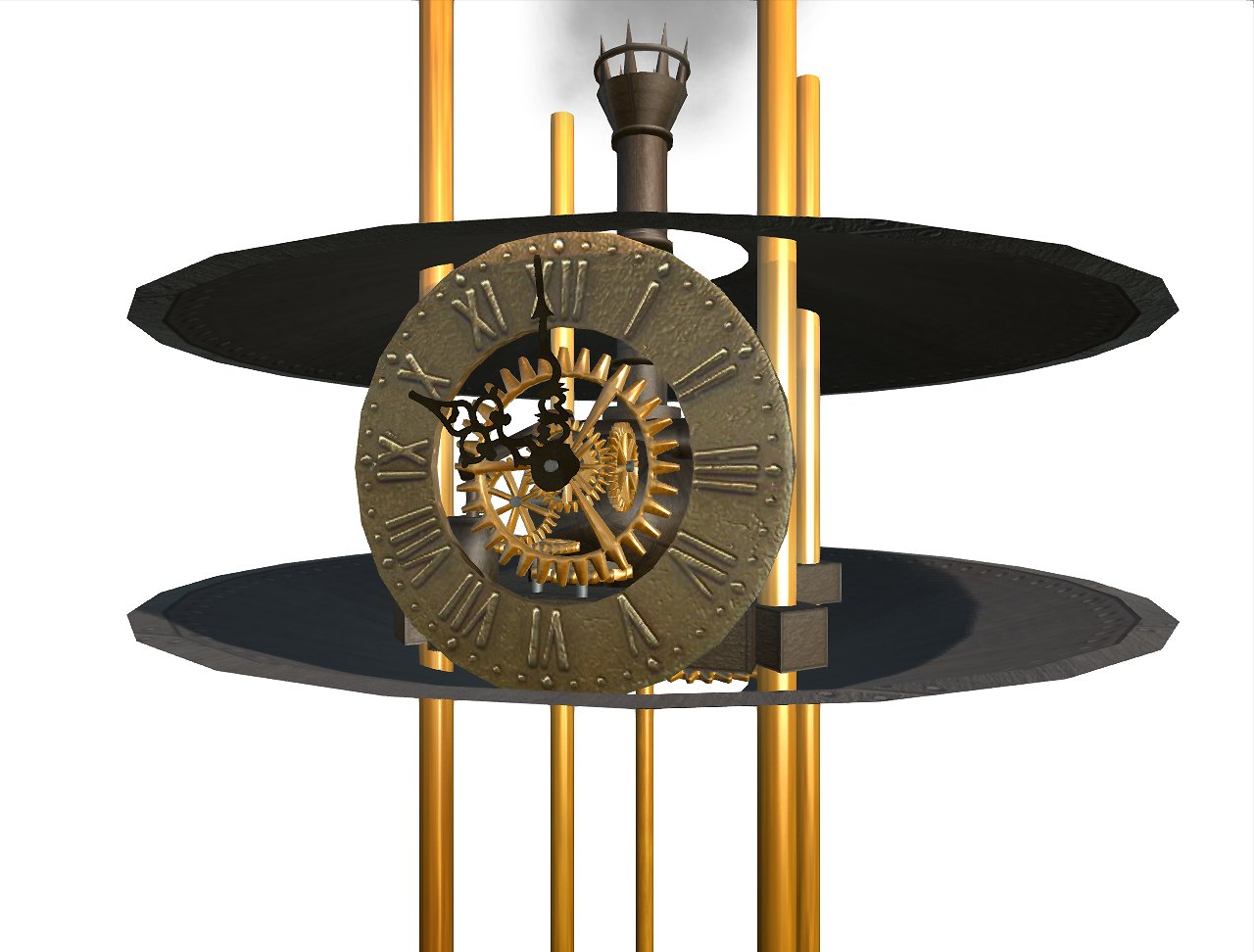
Clocks are one of the most important items for a Steampunk! No matter if they are room-decoration, fashionable accessory, components of time-machines, time-bombs or evil machineries to take over the world. Steampunks love their clocks! The more the better! Clocks are cool because they have nice clockfaces with fancy letters and lovely ornamental clock-hands and a clockwork with (I hope you guessed) tons of gears!

Steampunks usually love to tinker with clockworks and if a construction doesn't has lots of gears and springs which happily move and turn and ticktock along, its likely that it won't work at all!

Mechanic clocks combine both traditional elegance and technology in perhaps the best possible way and are therefore one of the definite icons of the Steampunk culture. If you don't get the clock-thing, you surely won't get whole steampunk-thing too.